

Assistant Professor of Environmental Science and Studies
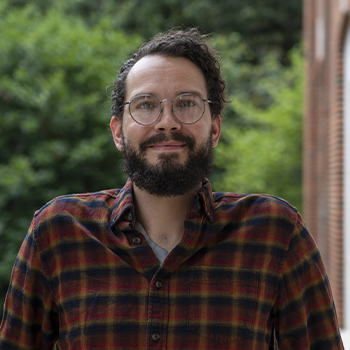
Dr. Andrew C. Eagar is an assistant professor in the Department of Environmental Science and Studies. He primarily studies microbe-environment interactions in a global change context, investigating how mutualistic, pathogenic, and free-living communities of microbes shape plant and microbial community dynamics and ecosystem function. He is an interdisciplinary ecologist and evolutionary biologist that has studied bacteria and fungi in a variety of environments, including hardwood forests, freshwater streams, and urban green roofs.
His lab uses cutting-edge molecular and statistical techniques to identify, quantify, and characterize microbial communities in order to study the promotion of positive relationships and mitigation of negative relationships between microbes and their environment. With a background in geology and environmental biology, Dr. Eagar teaches a variety of classes related to the Earth system, including an introduction to Earth system science class, an ecosystem science class, and a soil science class.
Education
- Ph.D., Ecology and Evolutionary Biology, Kent State University
- B.S., Environmental Biology, Tennessee Tech University
- B.S., Geology, Tennessee Tech University
Teaching Interests
- Earth System Science
- Ecosystem Science
- Soils
Research Interests
- Community Ecology
- Ecosystem Ecology
- Microbial Ecology
- Soil Science
Selected Publications
- Eagar, A.C., Abu, P.H., Brown, M.A., Moledor, S.M., Smemo, K.A., Phillips, R.P., Case, A.L., and Blackwood, C.B., 2024. Setting the Stage for Plant-Soil Feedback: Mycorrhizal Influences over Conspecific Recruitment, Plant and Fungal Communities, and Coevolution. Journal of Ecology.
- Hossain, M.R., Eagar, A.C., Blackwood, C.B., and Leff, L.G., 2024. Bacterial community composition progression on microplastic disks in a freshwater stream. Journal of Environmental Quality.
- Eagar, A.C., Phillips, R.P., Smemo, K.A., and Blackwood, C.B., 2023. Context-dependence of fungal community responses to dominant tree mycorrhizal types in Northern hardwood forests. Soil Biology & Biochemistry, 108971.
- Bhattacharyya, S., Eagar, A.C., Engohang-Ndong, J., and Leff, L.G., 2023. Antibiotic resistance gene abundance and bacterial community composition in macroinvertebrates of an urban stream. Freshwater Biology,68 (7), 1107-1121.
- Droz, A.G., Coffman, R.R., Eagar, A.C. and Blackwood, C.B., 2022. Drivers of fungal diversity and community biogeography differ between green roofs and adjacent ground‐level green space. Environmental Microbiology, 24 (12), 5809-5824.
- Eagar, A.C., Mushinski, R.M., Horning, A.L., Smemo, K.A., Phillips, R.P., and Blackwood, C.B., 2021. Arbuscular mycorrhizal tree communities have greater soil fungal diversity and abundances of saprotrophs and pathogens compared to ectomycorrhizal tree communities in temperate forests. Applied & Environmental Microbiology88 (1), e01782-21.
- Mason, L.M., Eagar, A., Patel, P., Blackwood, C.B. and DeForest, J.L., 2020. Potential microbial bioindicators of phosphorus mining in a temperate deciduous forest. Journal of Applied Microbiology, 130(1), pp. 109-122.