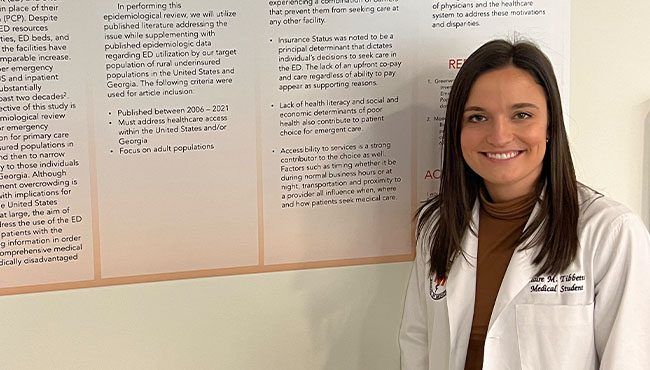
Claire Tibbetts ’19 is an emergency medicine resident at The University of Tennessee Health Science Center College of Medicine-Chattanooga (affiliated with the teaching hospital system, Erlanger Health). She laughs, saying she’s probably the only resident offered extra credit for bringing roadkill to an undergraduate class.
“In an epidemiology course at Berry, we discussed the ethics of studying animals,” says Tibbetts. “We learned that we could ethically culture the intestines of deceased animals for parasites. It was crazy and so cool. I was always trying to get written into this professor’s courses because they were challenging but so hands-on.”
Tibbetts is finishing her residency and hopes to pursue a fellowship in critical care. She believes her Berry education provided a strong undergraduate foundation. She valued being known and seen. After switching to the pre-med track, she spent significant time in office hours with Pre-health Advisor Chris Mingone.
“We still keep up,” says Tibbetts, “But it wasn’t just Mingone. At one point, I was on an indoor intramural soccer team with three chemistry professors.”
Courses in the humanities reinforced communication skills and the ability to listen to different ideas. That played into her confidence to deal with a variety of patients.
Professional development had an impact. Working at Berry’s on-campus health center provided leadership experience and taught her how to meet people where they are. Off-campus Tibbetts served as a medical scribe at Redmond Hospital (now AdventHealth Redmond).
Tibbetts has since been involved with research on communication in emergency medicine, with one publication examining outcomes for non-English-speaking patients and another exploring barriers faced by patients who use American Sign Language.
When asked what drew her to emergency medicine and critical care, Tibbetts says she appreciates that ER never turns away people who are unable to pay. She also loves the critical thinking the field requires.
“If somebody comes in confused and in shock and we’re trying to figure out what’s causing it, that's one of my favorite cases,” she says. “I like the puzzle.”