STORY BY RICK WOODALL
Photography by Ed Cunicelli
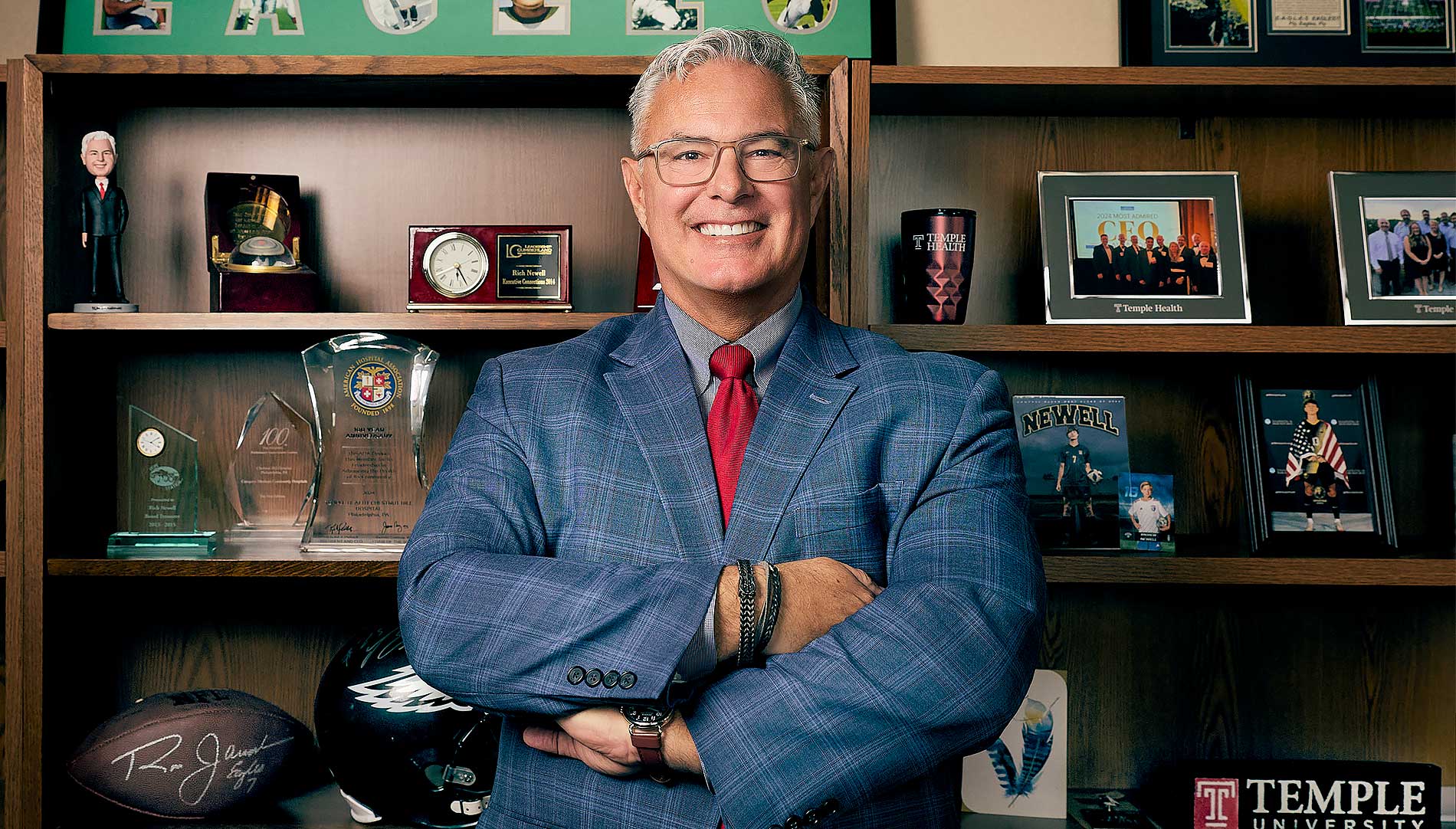
Some lessons resonate for a lifetime. So it’s been for Dr. Richard Newell (89C), whose unconventional career arc through pharmaceutical sales, physical therapy practice and finally health care administration mirrors wisdom once shared by his father.
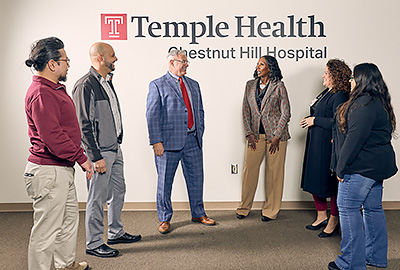
“I don’t know if it was ever a conscious path,” mulled Newell, now 59, who in 2024 stepped into his latest leadership role as president and chief executive officer of Temple Health-Chestnut Hill Hospital in Philadelphia. “My dad taught me early on that whenever an opportunity comes you say yes. You don’t say maybe. You don’t say let me think about it. You don’t say no. You just say yes and do a good job. That’s how you provide value to your organization and grow in your career.”
Doing so requires an openness to new challenges evidenced by Newell’s early-career pivot to physical therapy, which necessitated a move to Philadelphia for PT school. Even more dramatic was his willingness to step out of a perfectly good airplane not once, not twice, but more than 1,500 times as a skydiver (read more in sidebar below).
“I take calculated risks,” Newell emphasized. “I ponder and do my due diligence first, then jump in.”
Such was the case with his decision to assume the “intense responsibility” of guiding Chestnut Hill’s resurgence as a vital health care lifeline with roots in its community dating back nearly 125 years.
“My wife was born here. Her brother was born here. Several of her uncles were born here,” Newell said of the 148-bed facility, which since 2023 has operated in partnership with Temple Health and the Philadelphia College of Osteopathic Medicine. “Those connections bring it full circle, in that what we do impacts a whole community and a history of people who have ties to this hospital. So we take very seriously our job of providing great care, convenience and access to the people of Chestnut Hill and Northwest Philadelphia.”
Patient to Practitioner
A career in health care wasn’t on Newell’s radar when he graduated from Berry in 1989 boasting a long list of impressive accomplishments, including three years as men’s soccer captain; senior All-America recognition (academic and athletic); one subsequent season as a student assistant coach; and a double major in business administration and economics. He also completed four quarters of paid co-op work experience with Siemens Energy and Automation, visiting cities nationwide as he cycled through various aspects of the company’s operation.
Post graduation, Newell spent several years in North Carolina working in sales and as a regional trainer for what is today the multinational pharmaceutical and biotechnology company GSK plc – an opportunity earned in part due to his experience as a student-athlete and his Siemens co-op – before a severe ankle injury suffered in a recreation league volleyball game brought a different future into view.
Undergoing extensive rehabilitation after reconstructive surgery, Newell gained profound appreciation for the outpatient physical therapists tasked with helping him to regain mobility. Intrigued by their example, he started taking night classes to gain the science prerequisites necessary for a possible return to school. Volunteer stints at local hospitals only steeled his resolve.
“In pharmaceuticals, I worked with physicians, physician’s assistants and pharmacists. I didn’t really have any interaction with patients, and I thought that might be more of what I was geared for,” he related. “That’s what I saw happening in physical therapy.”
Inspired, Newell left the pharmaceutical field and set off for Philadelphia (at the time a hotbed of the nation’s top PT programs), eventually earning master’s and doctoral degrees from Temple University. Along the way, the Hollywood, Florida, native who grew up in Atlanta met fellow PT student and future wife Stefanie, with whom he now has three children ages 11 to 22.
“She was from Philly; I was from South Florida,” Newell joked in a video interview produced by the Rotary Club of Chestnut Hill. “We’re still in Philly, so you see who won that battle.”
Leadership path
During his years of active practice, Newell assisted patients facing all manner of rehabilitation challenges, including severe burns, sometimes working for a year or more to help restore a sense of normalcy to their lives.
“The best part about being a physical therapist is the amount of time you get to spend with patients,” he described. “You learn about their challenges, their families and their jobs. It’s just such a great field.”
While taking great satisfaction in such work, Newell steadily accepted new responsibilities as supervisors perceived the same leadership qualities that once earned him the title of Berry team captain. His performance in those roles, coupled with his perspective as an active practitioner, ultimately started him up the ladder of hospital administration as a business development liaison serving as a bridge between the chief executive and medical staff.
“With my clinical experience and marketing and business background dating back to Berry, this was right up my alley,” Newell said of that initial role in administration, adding that while not claiming to be a “doc whisperer,” his ability to speak the language of both worlds “helped conversations go more smoothly.”
From there, Newell assumed such titles as chief operating officer, CEO and finally CEO/president of two hospitals prior to Chestnut Hill, all the while keeping his physical therapy skills fresh with occasional weekend and holiday shifts. The “chaos” of the COVID-19 pandemic finally forced him to set that work aside, though he continues to keep his license current.
“My goal was to be a good physical therapist and take great care of patients,” he expressed. “But opportunities led to titles and leadership roles. It really just came down to always saying yes, yes, yes.”
Business of caring
With more than 350 board-certified physicians among its 1,000-plus employees, Chestnut Hill offers treatment in 16 specialties to patients across the socioeconomic spectrum. There’s also a bustling emergency department that logs upward of 45,000 visits annually.
As president and CEO, Newell strives to solidify gains made since the hospital’s acquisition by Temple Health and PCOM, focusing particular attention on quality of care.
“No one wants to be at the hospital,” he acknowledged. “They’re here because something’s wrong. We deal with people at their most emotional, anxious and fearful. Whether it’s cancer, heart attack or stroke, we have to deliver life-altering news on a daily basis.”
One way Newell seeks to do right by both patients and staff is by fostering a collaborative decision-making environment in which those on the frontlines have a say in changes with potential to impact care (switching to a new type of equipment, for example).
“I’ve become a big fan of pilot programs,” he stated. “Try it for a month and see what happens before we invest big one way or another.”
Progress during his tenure can be measured by publicly reported quality-of-care indicators as well as growth in admissions, ER visits and surgical services, all of which reflect growing trust within the community. Once struggling, the hospital also has achieved a stable financial position at a time when many similar facilities are threatened.
Quick to share credit with others, Newell is extremely proud of what’s been accomplished. Still, it’s the affirmation from patients and their families that means the most.
“When people take the time to actually reach out and tell me what a great job my team has done or what a difference we’ve made in their lives, that makes my day,” he said.
Berry Reflections
Nearly four decades removed from his undergraduate days, Newell cherishes lifelong friendships with teammates and memories such as the Mountain Day soccer game (then played before huge crowds on the mountain campus). He’s also grateful for the lasting influence of his former coaches, Dr. Bob Pearson (FFS) and Bret Simon (82G, FFS), and faculty members including Drs. Ben Kyer (FFS), Dan McBrayer (FFS) and Janna Johnson (81C, FFS).
“Coach Pearson used to have mantras and sayings that just stuck in my head,” Newell laughingly shared. “I remember him saying, ‘If it were easy, they wouldn’t need you,’ and 45 years later I’m still saying that.”
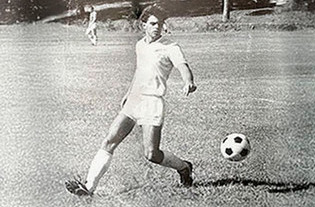
Similarly, lessons taught by McBrayer highlighting the importance of body language and remembering people’s names continue to shape Newell’s interactions with others.
Combined with Berry’s emphasis on relationships, work ethic and team, the knowledge and support supplied by teachers and mentors positioned Newell for success long before his path became clear, providing a “great foundation” for every “yes” yet to come.
Taking the plunge
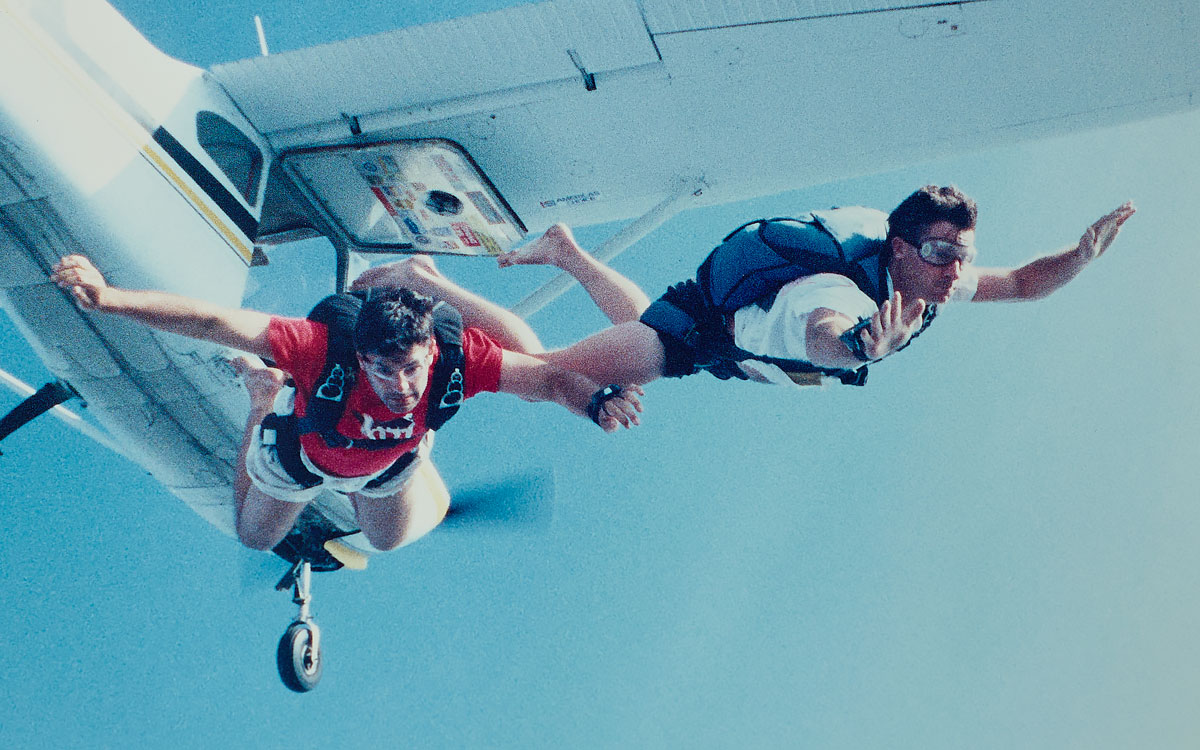
Dr. Richard Newell, at left above, has built a career out of saying “yes” to opportunity, but when asked to go skydiving in his early 20s, he initially declined.
Then working in pharmaceuticals, Newell had grown up listening to stories told by his grandfather, a paratrooper with the 82nd Airborne during World War II, but that didn’t mean he wished to follow his example.
Nevertheless, Newell accompanied his friend to the tiny Farmville, North Carolina, airfield then home to the “Dismal Swamp Skydiving Club” run by former Green Beret Lonnie Willer. Seeing how much fun everyone else was having, Newell eventually decided to have a go himself, jumping twice by day’s end. The following Monday he went up again, this time clad in the business suit he’d worn to a morning sales call, having been drawn back to the airfield by the sound of a radial engine flying overhead.
Hundreds more jumps would follow in the coming years, including record-breaking “big-way” attempts in which Newell joined 100-plus fellow enthusiasts in large-scale formations, airshow performances with the Pepsi skydiving team and a stint as “Flying Elvis” (lending new meaning to the term “jumpsuit”). He only stopped when wife Stefanie became pregnant with the first of the couple’s three children.
“I recognized that if it’s just me it’s one thing, but if there are people relying on me it’s time to step back,” he explained. “I think 1,502 was my last jump.”
True to his word, Newell hasn’t donned a chute in more than 22 years, but he has held onto his gear, thinking he might yet take another leap once his youngest (currently 11) goes to college. Even after all this time, the experience remains vivid in his mind.
“I don’t care how big of an adrenaline junkie you are, nothing can compare to when you separate from the airplane, go into free fall and see the ground beneath you,” Newell described. “When the parachute opens there’s this calm that comes over you because you’re under the canopy and it’s just silence all around.
“Jumping up here in the Northeast, I’d get out of the plane and, depending on which direction I was facing, see New York City, Chesapeake Bay or the Atlantic Ocean,” he added. “From altitude, you would see jets at your same level off in the distance. It’s just the most insane peace that you’ll ever experience until it’s time to land and you get that second rush of adrenaline.”
Touching down always triggered a release of endorphins Newell likened to finishing a marathon, followed by one overriding thought: “Yes! I want to do that again!”