News & Stories
A student and a faculty mentor at a computer.
August 28, 2025

Motivating College Students, What Really Works

As the fall semester begins, many colleges invite experts to address the biggest challenges in higher education. This year, Berry College welcomed Dr. David Yeager, psychology professor at the University of Texas at Austin and cofounder of the Texas Behavioral Science and Policy Institute, to speak on the science of motivating young people.

The Disconnect

Many well-meaning authority figures unintentionally demotivate students by taking a top-down approach: “I’m older and wiser. Listen and learn!” Yeager coined the term, “grownsplaining,” and though it may sound obvious, many adults accidentally nag and talk down to young people in an effort to share knowledge.

Using a comparison of an ineffective non-smoking campaign vs. the most effective non-smoking campaign in history, Yeager expressed how “telling” younger ages 10-25 vs. motivating them took completely different strategies.

Dignity Builds Trust

Referencing a famous non-smoking campaign, “Think, Don’t Smoke,” in his book and talk, Yeager describes how this tagline made assumptions about the 10-25 age group. By telling the target audience to think, the marketing company made the assumption that the listeners were not thinking, disrespecting them. Adding a command to the end of the tagline did not help their case. Ultimately, “Think, Don’t Smoke” was a failure. The non-smoking campaign actually increased levels of smoking in the US.

In contrast, the non-smoking campaign, “The Truth Campaign,” heavily exposed the way the tobacco industry targeted and preyed upon young people. Rather than telling young people how to think, the campaign earned young people’s respect. It suggested that, presented with the truth, young people would be motivated to stop what was happening in the tobacco industry. And that’s just what happened. Teen smoking fell from 23% to 2%. The point here? Respect builds motivation, and without it, it can be very difficult to motivate the age group.

Between the ages 10-25, it is regularly documented that people have high sensitivity to two specific areas:

  1. Social status (how they're perceived)
  2. Fear of failure (risk of embarrassment or rejection)

For parents, teachers or any mentors, showing a student respect while also watching out for these sensitivities can feel like walking in a field of land mines, especially in college. How, then, does a mentor help someone in this age group navigate starting college? How can they show respect while also offering the feedback and growth students need?

The Mentor Mindset

For starters, mentors can harness the sensitivities of this age group, similar to the way marketers did in “The Truth Campaign.” Yeager calls this approach “The Mentor Mindset,” describing a culture of respect that pairs high expectations with meaningful support.

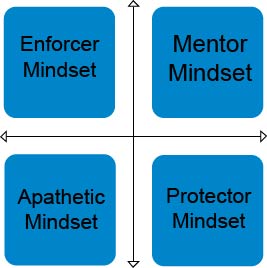
The Mentor Mindset is one of four common mindsets Yeager says most authority figures fall into:

  • Enforcer: High standards, low support → fear-based motivation
  • Protector: High support, low standards → comfort without growth
  • Apathetic: Low standards, low support → disengagement
  • Mentor: High standards and high support → trust and motivation
${_EscapeTool.xml($imgAlt)}

The Big Four

Putting these figures in different categories, he describes the enforcer as one who has high standards with little support. This type focuses on obedience and fear of consequences for motivation.

Though it can be effective in the short term, it rarely cultivates a love of learning or authentic motivation. Opposite of the enforcer is the protector mindset. These authority figures offer high support but do not hold students to high standards, eventually eroding their motivation. They sacrifice long-term knowledge for short-term comfort or feelings. Providing only low expectations also communicates that the authority figure does not believe the student is capable. And without any challenge or stress, students never learn problem-solving and resilience on their own.

The most balanced approach is the mentor mindset where an authority figure has high standards while offering high support. For example, Yeager shares about a research project where they looked at students' willingness to revise their writing when the feedback was included with a note that read: “I'm giving you these comments because I have very high expectations, and I know that you can reach them.”

The note communicated that students don’t have to be perfect but that they are capable, while also suggesting that they are respected. Without the note for context, Yeager argues even the most well-meaning professors might accidentally hinder motivation. In the study, those who received the note were more likely to revise their writing than those who did not.

Key takeaways for motivating students:

  • Respect builds motivation: Avoid “grownsplaining,” condescending tones or nagging. Instead, treat students as capable individuals rather than passive recipients of wisdom.
  • Understand developmental sensitivities: Remember that ages 10-25 are sensitive to social status (how they’re perceived) and fear of failure (risk of embarrassment or rejection); consider this as you create assignments and give feedback.
  • Adopt the Mentor Mindset: Don’t forget that high expectations with high support are the most effective combination. Forms of feedback and criticism should be framed in a way that protects dignity while encouraging hope, communicating belief in the student’s potential: “I’m giving you these comments because I have high expectations and I know you can reach them.”
  • Avoid the extremes: Try not to use fear-based motivation that asks students to meet high standards with little support but also don’t swing so far in the other direction that you offer comfort without challenge.

In conclusion, Yeager argues for relational motivation, a message that aligns with Berry’s long-standing culture of mentorship. Founded on Martha Berry’s ideals of people helping people, Berry gladly invests time and effort on important work of guiding, supporting and inspiring one another. Yes, mentors inspire students AND students inspire mentors.

With a student body of 2,153 and 607 faculty, staff and coaches, students are known, supported and challenged. Here, the mentor mindset isn’t a theory, it’s a practice.

Want to learn more about Berry’s approach to student success? Explore Berry here.

 Back to Top